Shine On
Electromagnetic spectrum:

Demonstration video:

Idea launchers:
- Names five different kinds of waves.
- How are all the waves the same?
- How are the waves different?
- Which types of radiation do you recognize in the provided spectrum?
- Which color has the shortest wavelength (λ) according to the spectrum?
- Why does a CD or DVD look like a rainbow of colors when you look at it?
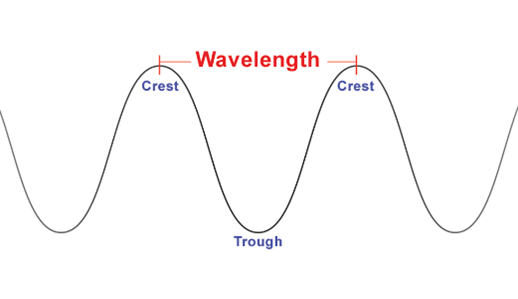
Wave illustration:
Landing pad:
- Did you see different things with different light sources?
- Did you see emission or absorption spectra?
- How was sunlight different from the discharge tubes?
- If your shirt looks blue, what color does it absorb?
- What color would you predict the sky to look in a forest fire area?
- What similarity did you notice between the wavelength of the visible light and the spacing in your CD?
Rays of knowledge:
- Light is energy that comes from the sun as a continuous spectrum. We can see how this white light separates into colors and produces a rainbow when there are small water droplets in air.
- Lots of things can happen to light as it travels.
- It can be transmitted — passes through something like clear glass.
- It can be reflected — bounces back like what a mirror does.
- It can be refracted — bent and changed like when the light goes from air to water, such as a straw in a glass looking “broken.”
- It can be absorbed — captured by something and not returned. If your shirt looks red, it is because it absorbs green light.
- It can be scattered — gas molecules and dust send light in every direction. Blue scatters more than other colors, so the sky looks blue. With smoke or at sunrise/sunset (longer path), red/yellow become more visible.
- It can be diffracted — light waves bend around openings; greater wavelength gives more diffraction.
- Different light sources give off different wavelengths of light. One way to see this is to bend light into its component wavelengths using a diffraction grating.
- CD is made of plastic with many tiny grooves ~1.6 microns (1.6×10⁻⁶ m) apart. As light interacts with the grooves, it is bent; longer wavelengths are bent more than shorter wavelengths.
- Absorption spectrum looks like a dark background with light-colored lines.
- Emission spectrum looks like a rainbow of colors with dark lines.
- Applications Both emission and absorption spectra are like fingerprints for elements. Even for distant stars, composition can be inferred from their spectra — this is how helium was discovered.
| Electromagnetic Radiation:
|
Energy of Electromagnetic Radiation:
|